
Guide
Soy candles – what they are, why they’re better and how to choose
Soy candles have become a favourite for the home in recent years, but there is also a lot of marketing around them. In this guide we explain honestly what soy wax is, how it differs from paraffin, beeswax and coconut wax, how to recognise a real soy candle and how to care for it so it burns long and evenly.
CandleArtUpdated 7 min read
Contents
- 01What is soy wax?
- 02Soy, paraffin, beeswax or coconut wax — a comparison
- 03The benefits of soy candles (and what isn’t true)
- 04How to recognise a real soy candle
- 05Wooden or cotton wick?
- 06How to light and care for a soy candle
- 07How we pour every soy candle by hand
- 08How to choose a soy candle
- 09Soy candle FAQ
We write from experience: at CandleArt we pour soy candles by hand every day, and here we have collected the answers to the questions customers ask us most often.
What is soy wax?
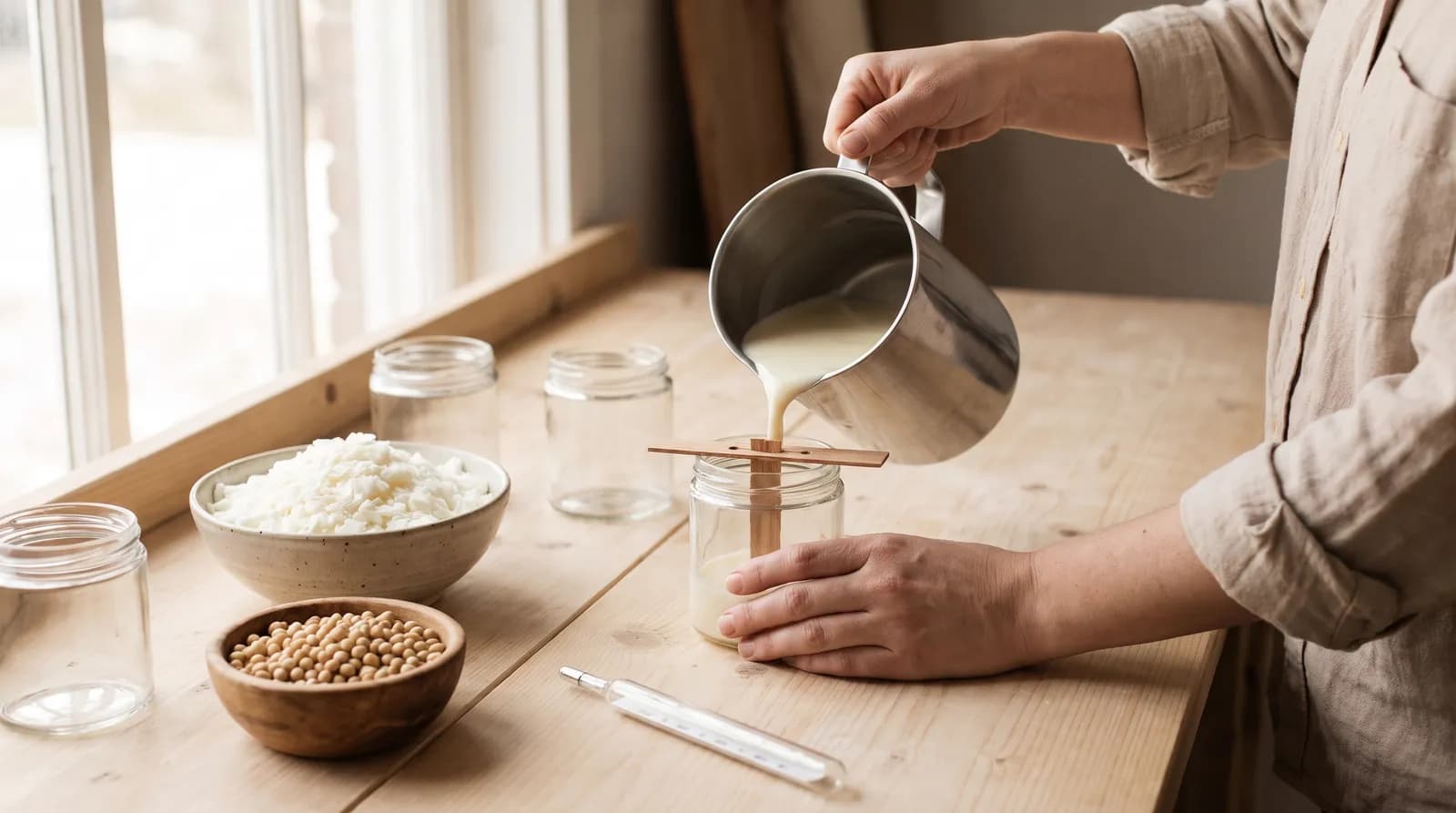
Soy wax is made from soybean oil. The oil goes through hydrogenation, a process that saturates part of its fatty acids and turns the liquid oil into a soft, creamy wax. The result is an entirely plant-based, biodegradable material from a renewable source.
Container soy wax is soft and melts at a low temperature — around 46–54 °C. That is why it burns cooler and slower than most paraffins, and melted wax is less likely to burn your skin if you touch it by accident.
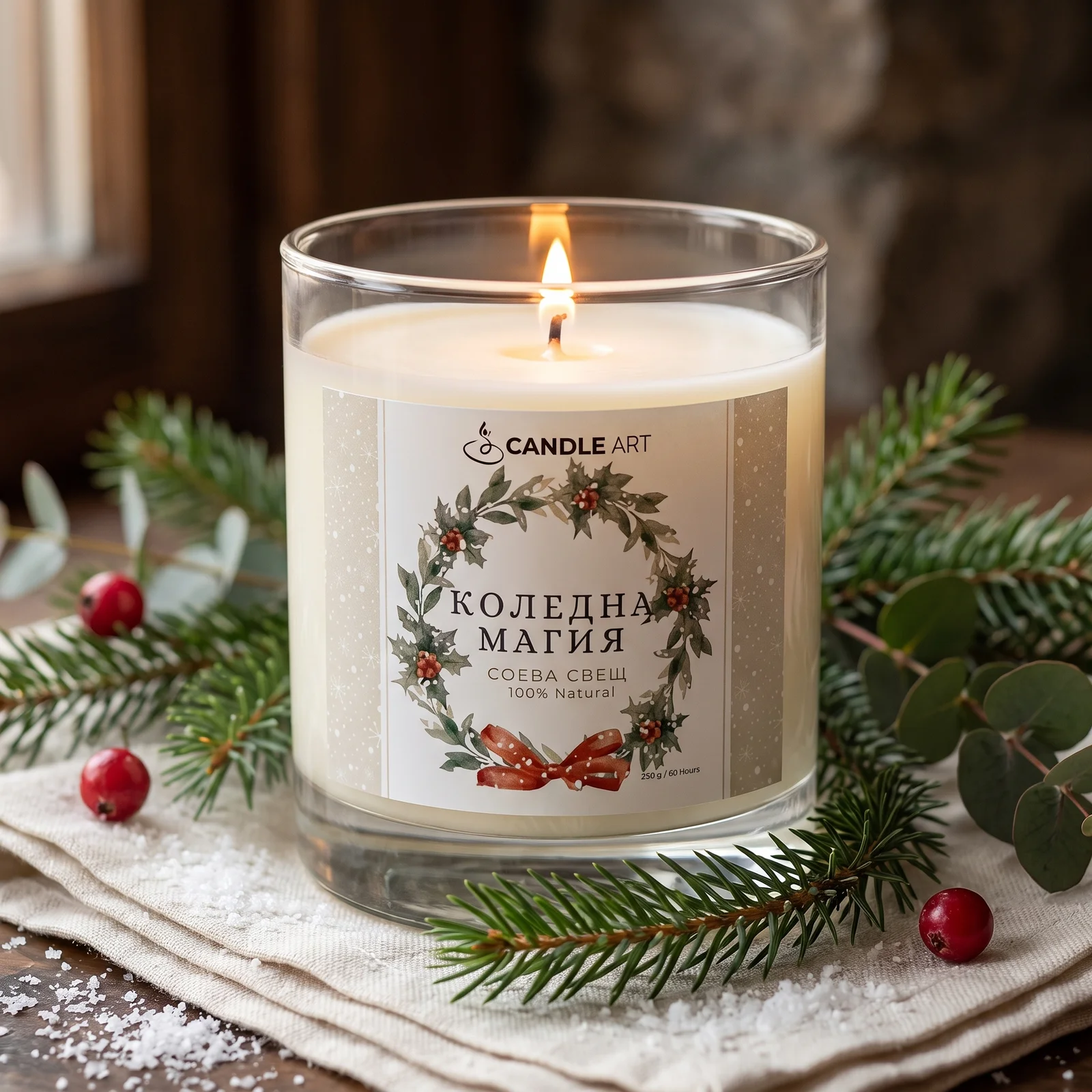
A soy candle typically looks matte and creamy rather than glossy and translucent. Sometimes white crystals (“frosting”) or lighter patches appear on the surface or along the jar. This is a natural property of soy wax and does not affect the burn or the scent.
Soy, paraffin, beeswax or coconut wax — a comparison
There is no “perfect” wax — each has its strengths. Here is how the most common ones compare:
Wax | Source | Burn | Scent | Price |
|---|---|---|---|---|
Soy | Plant-based (soybean oil) | Slow and even, little soot | Soft, even | Medium |
Paraffin | Petroleum by-product | Faster, more soot with a long wick | Strong | Low |
Beeswax | Natural (honeycomb) | Very slow, bright flame | Its own honey scent | High |
Coconut (usually a blend) | Plant-based (coconut oil) | Slow, very creamy wax | Excellent | High |
Palm | Plant-based (palm oil) | Hard, crystalline pattern | Good | Medium |
Soy wax is the best all-round choice for a scented candle at home: plant-based, long-burning, carries scent softly and is reasonably priced. Beeswax is lovely but smells of honey itself and takes other scents poorly. Coconut wax is luxurious but almost always blended with other waxes. Palm wax raises concerns about tropical deforestation.
The benefits of soy candles (and what isn’t true)
Longer burn — thanks to its low melting point, a soy candle usually burns longer than a paraffin one of the same weight.
Less soot — with a trimmed wick, a soy candle leaves hardly any black marks on the jar, walls or furniture.
Soft, even scent — the oils are released gradually rather than hitting you at the door.
Plant-based and biodegradable — spilled soy wax cleans up with warm soapy water.
Reusable — the empty jar cleans easily and makes a glass or a small plant pot.
No myths
What isn’t true: a soy candle doesn’t “purify the air” and isn’t “completely smoke-free”. Every flame releases some substances, whatever the wax. The advantage of soy is its plant origin and a cleaner burn with proper care, not miracle effects. If someone promises otherwise, be sceptical.
How to recognise a real soy candle
The label says “100% soy wax”. A “soy blend” can contain a large share of paraffin.
The surface is matte and creamy, not glossy. A few white crystals are normal.
The wax is soft — a fingernail leaves a mark, while paraffin is harder and waxy-glossy.
Melted wax is warm, not hot, and washes off with soap and water.
The price is realistic: a 100% soy handmade candle can’t cost as little as a mass-produced paraffin one.
Wooden or cotton wick?
A cotton wick is the classic choice: it burns quietly with a calm, predictable flame. It suits a candle that sits in the background while you read or work.
A wooden wick crackles softly like a fireplace in miniature, with a wider, lower flame. It adds sound to the light and scent and is a favourite for cosy evenings. It needs a little more care when lighting — hold the lighter for a few seconds until the flame takes.
With our candles in jars you choose the wick yourself — every candle page has a “Wick” option.
See candles with a choice of wick →
How to light and care for a soy candle
The first burn matters most
The one rule that matters
Soy wax has a “memory”. If you blow the candle out the first time before the melted wax reaches the sides of the jar, it will tunnel on later burns and leave unburnt wax around the edge. So the first time, let it burn until the whole surface has melted — roughly 1 hour per 2.5 cm of diameter (usually 2–3 hours).
Every burn after that
Trim a cotton wick to about 5 mm and a wooden wick to about 3 mm. A longer wick smokes and blackens the jar.
Don’t burn the candle for less than an hour, or for more than 4 hours at a time.
Put it out with a lid or snuffer instead of blowing — no smoke and no splashing wax.
Stop burning when about 1 cm of wax is left at the bottom, so the jar doesn’t overheat.
Safety
Place the candle on a flat, non-flammable surface, away from draughts, curtains and shelves above it.
Keep candles at least 10 cm apart and out of reach of children and pets.
Never leave a burning candle unattended, and don’t move it while the wax is liquid.
Storage
Keep the candle somewhere cool and dark, ideally with a lid. Direct sunlight and heat fade the colour and weaken the scent over time.
How we pour every soy candle by hand
This is how one of our candles goes from wax to your home:
Heating. The soy wax is melted to exactly the right temperature — no hotter than needed, so it keeps its qualities.
Adding the scent. The fragrance oil is added by hand, in the right ratio to the wax, while the temperature is still right.
Pouring. The wax is poured in small batches, and the wick is centred before pouring so it burns straight and evenly.
Setting and curing. The candle is left to set and cure for about 48 hours before it is checked and packed.
How to choose a soy candle
Living rooms and large spaces — a larger candle in a jar with a stronger scent, such as our perfume candles.
Bedroom and bathroom — soft, warm scents: vanilla, sandalwood, lilac.
Kitchen — fresh and gourmand scents: citrus, apple, coffee.
As a gift — decorative candles shaped as a rose, heart or tree, or small candles as favours for guests at an event.
For the holidays — Christmas candles with cinnamon, tangerine and caramelised apple.
Soy candle FAQ
How long does a soy candle burn?
It depends on the candle’s weight and wick. The approximate burn time is listed on each of our candle pages. What helps most is not burning it for less than an hour and trimming the wick.
Why is my candle tunnelling?
Usually because the first burn was too short. Let the candle burn until the melted wax reaches the sides of the jar. If a tunnel has already formed, wrap the rim with aluminium foil, leaving an opening in the middle, and burn for 1–2 hours — the heat will level the surface.
What are the white patches on my soy candle?
They are natural soy wax crystals (“frosting”) or spots where the wax has pulled away from the glass. They are cosmetic and don’t affect the burn or the scent.
Are soy candles safe in a home with children and pets?
Yes, with normal safety measures: keep the candle stable, out of their reach and never unattended. Air the room, especially if someone is sensitive to scents.
Can a soy candle burn without a jar?
Candles made for jars aren’t meant to burn without one. Always light our decorative shaped candles (rose, heart, tree, bubble) on a plate or non-flammable tray, as the wax spreads as it melts.
How do I clean the jar when the candle is finished?
Put the jar in the freezer for a few hours — the leftover wax shrinks and pops out easily. Then wash it with warm soapy water.